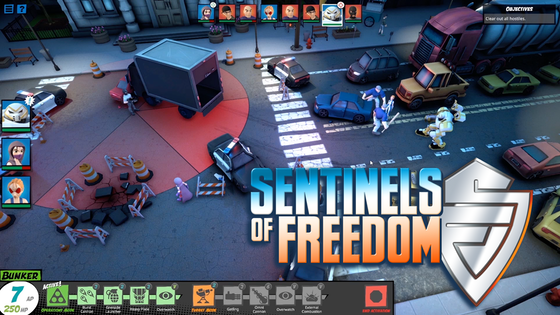
A digital turn-based strategy game inspired by the Sentinel Comics RPG. Create your hero. Build your team. Save the world.
Latest Updates from Our Project:
Update - More Tactics
about 7 years ago
– Mon, Jul 29, 2019 at 11:26:08 PM
This post is for backers only. Please visit Kickstarter.com and log in to read.
Whiteboxing
about 7 years ago
– Mon, Jun 10, 2019 at 09:33:13 PM
What is whiteboxing? The process of taking all the big ideas and chicken scratches from the design phase and bringing them into the game engine. Very simple objects are used to represent core elements of the encounter, typically primitives like boxes and cylinders. These basic objects make tweaking encounters very fast and provide a foundation for environment artists to start creating assets.
Sentinels of Freedom was created in Unity, which offers an abundant amount of plugins for all different tasks. A key plugin used during whiteboxing was ProBuilder, a basic modeling tool that allowed designers to quickly create level objects right in Unity. Sometimes we used the tool to create more complex objects because simple primitives we not enough. Our designers were able to make this happen without disrupting the modelers from their tasks, saving a lot of time. These objects ended up looking so good - some were used for final art!
Once the scene is laid out with plans and white boxes, the next step is setting up the logic to turn the scene into an encounter. This process involves placing enemy spawn locations, creating objectives, identifying where the encounter needs to be split into smaller engagements, and setting the number of heroes available, both active and in reserve, along with their starting positions.
In the beginning, we can use these whitebox levels to get a feel for every level and identify any potential issues. Over time, however, these evolve and allow for a near final experience of the level - all that remains is updating the art and lighting.
Adventure with Purpose
about 7 years ago
– Tue, Jun 04, 2019 at 03:44:16 PM
Christopher Badell & Adam Rebottaro Discussing Story Design
In Sentinels of Freedom, we took a more "adventure" approach to mission and level design, expanding on what we did and learned from Super Dungeon Tactics. Many of the missions have two parts, Encounters and Engagements, which are grouped inside the overall mission.
Encounters are larger areas, typically involving a more drastic change of an environment. For example, a mission may start with fighting outside of a building (Encounter 1) before moving into the main floor (Encounter 2) until finally descending to the lower floor (Encounter 3). Between Encounters, typically players can swap active heroes with reserves, allowing different tactics and maximizing health pools.
Within each Encounter, there can be smaller Engagements. Each Engagement can spawn new enemies and have further objectives. Missions can also utilize this system to offer players options on which path they take - providing the player with more choice.
Missions can have any number of Encounters and Engagements offering a variety of challenges and length of play. Some missions may offer a short 15 minutes of action while others can take well over an hour.
When developing missions in Sentinels of Freedom, we started by referencing the story outline so we could create missions that support the main plot points. It was crucial to us the missions were a part of the storytelling process, not just action between story progress. Once these core missions were roughed out, we added missions to either further push the story or allow players to experience more of the universe.
After finalizing the mission outline, a list of key locations and enemies was created to provide a basis for design. Sentinels of Freedom offers an impressive number of unique enemies, quite a task for an indie studio, with each major plot shift offering new environments as well.
Level designers had access to more than just environmental changes and a large variety of enemies; tools were created to allow for a whole host of objectives including rescuing civilians, repairing generators, and even tower defense inspired objectives to name a few.
Lobby (concept)
Rough level designs are drawn up on graph paper and whiteboards with call outs to various events and enemy positions. These serve as a starting point when building the levels. While all this is very important and helpful, it leaves many partial ideas and questions. Is the level too large or too small? What does the evil base look like? We should have the bad guys do this! In the next phase of design, these questions get answered and ideas are formalized. While these may change over time - we start by shooting for the stars.
In short, we took a great deal of time crafting the levels in Sentinels of Freedom and we hope you enjoy the result of our effort!
Board Game to Video Game: Capturing the Feel
over 7 years ago
– Tue, May 14, 2019 at 01:51:01 AM
Our team was very excited to have the opportunity to work with such a great property. We were very familiar with Sentinels of the Multiverse and the Sentinels Tactics board game. Our first step was to play the games and jot down notes focusing on specific feelings and highlights that were throughout the games. While Sentinels of Freedom is a whole new game, we wanted to capture the essence of the property.
From our sessions, a few things stood out and we wanted to focus on them during our initial designs of the game:
Restricted Power.
In the board games, the cards represent your actions and abilities. Your characters are capable of doing incredible things and able to meet any challenge - if you had access to all cards at anytime. However, you only have access a select pool and you mush strategize on how best to use those available abilities.
We incorporated this mechanic into our Themed Stances. These Themed Stances allow the core character stats to be modified and restrict the character to use abilities that support that theme, creating a very focused state for the character. For instance, when Tachyon is in her Push the Limits stance, she is capable of dealing tremendous damage but all that effort has a cost - her HP is reduced with each attack. When she is switched to Hypersonic, her attacks are more focused and all balanced with some support and vigilance abilities.
In the paper prototype, the heroes had this amazing van as their vehicle!
Hero Sync
Many of the heroes can help fellow teammates with Hero Sync, making them feel more unified and powerful. We are able to add Sync Ability Triggers to some heroes' abilities that can have a heavy impact. Bunker, for instance, can receive an Assisted Reload, which provides more Action Points to continue his assault.
Even early on, enemies could move and attack as squads
Enemies Acting in Groups
In the board games, leaving minions alone can result in devastating attacks and loss of important HP. We brought this into the digital game by allowing enemies to create squads which group several enemies together. All these grouped enemies activate at the same time making their turn feel very powerful.
Development of the Prototype
Work began September of 2017 on design, prototypes, and art style discovery. We used miniatures from Sentinels Tactics as well as parts from other games to create a full setup. Each character had a full character sheet with abilities and instructions. Combat and Initiative was all determined through using a 20-sided die. While the digital version has greatly evolved since then, there are still strong ties to this origin.
Movement and range were based on inches and we used a flexible tape measure to determine valid actions. Some basic templates from other games allowed us to create blast radiuses and other area effects.
Measuring and area attack templates
When attacking, the first roll is used to determine your accuracy and if you hit or not. Many factors modify this base roll including your speed, any obstacles, and range. A very high hit number might even get you a damage bonus!
The second roll determined the type of damage from minimal to critical with each level doing a set amount of damage based on the ability. This roll could also be modified based on various bonuses and conditions.
Finally, the damage amount was determined with one last set of adjustments based on the health status of the target and their type of defenses.
Hit calculation software
This was a lot of calculations! We decided to created an attack simulation software to assist in the calculations and allow us to focus more on gameplay. This allowed our designers to iterate very quickly without having to constantly change code. Once the design was solid, we then started digital prototypes but still referenced the physical version to try out new ideas.
About Greater Than Games, LLC
Greater Than Games, LLC is a leading tabletop game developer and publisher based out of St. Louis, Missouri. Established in 2011, Greater Than Games is well-known for delivering engaging, richly-themed, highly-replayable card and board games.
Look for Greater Than Games titles in major markets worldwide.
BUNKER
over 7 years ago
– Tue, Apr 30, 2019 at 09:25:59 PM
THE HUGE POWER SUIT
THAT CHANGES MODES AND WIELDS THE RIOT CANNON!
This week, we're focusing updates on BUNKER, releasing images and videos on Facebook, Instagram, Twitter and YouTube. However, we're giving you a first-look at what's to come!
BUNKER Q&A
Do you have questions about how BUNKER will look, how he's going to work in-game, etc? Send your questions to [email protected]
Later this week, Cory Heald (Team Captain) will be sitting down with Brian Olmstead (Artist), Cris Miles (Designer) and Levi Schneidewind (Developer). They'll answer your questions and then release the video on Facebook and YouTube.
Tyler Vance grew up in Boulder City, Nevada and had never seen anything outside that town. He worked in his father's auto-repair shop as a teenager, but he longed to get out of the desert and see the rest of the world. As soon as he finished school, he enlisted in the Army. They sent him to join the forces in the Middle East, merely sending him from one desert to another. There, he was quickly promoted through the ranks in an armored division. Lieutenant Vance and his platoon saw a lot of action in a short amount of time, but with very few casualties.
When Tyler arrived back in the States, he was awarded for his valor with the Army's Distinguished Service Cross. After the ceremony, he was offered a chance to further serve his country by participating in the Freedom Five Initiative. While operating outside the official Army chain of command, the position would provide Vance with a unique opportunity; he would operate the Personal Armament Exo-Chassis YS-1300T suit, an automated battle suit capable of wielding the firepower of a full battalion. Vance accepted the offer and became the first mechanized officer in the U.S. Army and also a founding member of the Freedom Five, providing significant strategic planning before most of the Freedom Five's missions.
In the last few years, Lt. Vance has grown closer to his teammate known as Wraith. Maia Montgomery leads a very different life than her heroic alter ego, yet both Maia and Wraith are people that Tyler gets along with well, respecting her abilities in battle, her shrewd thinking as a business owner, and her ability to handle stress and adversity in any form.
Recently, the US Military was revealed to be capturing and training powerful individuals and hoarding items of great power. Lt. Vance's duty to his superior officers was running in direct conflict with his duty to his team. It was a bit of a shock when he was promoted to Captain, as his superiors had made it clear that they considered his actions to be more civilian than military, but he had little time to consider these developments. OblivAeon had come to Earth.
Together, the Freedom Five fought alongside all of the heroes of Earth and beyond against a foe that threatened all reality: OblivAeon. Bunker fought in the defense of all, and now, after that climactic battle, still works to defend those who cannot defend themselves. Working with brilliant inventor and fellow hero Tachyon, he developed a new Bunker suit that utilizes one powerful weapon: the Riot Cannon. It is as configurable as the suit itself, making sure that Captain Tyler Vance is the Bunker he needs to be, no matter the threat.
Brian Olmstead has years of experience working on a huge variety of projects, allowing him to create fantastic art and a process enabling others to reproduce his techniques. Brian is a workhorse from the start of the day till then end - headphones on and hunched over his Cintiq display.